
With Maryville College in our rearview mirror, we reluctantly headed south on Highway 129 to go home. I adjusted my seat and slowly sipped my tea, knowing that we wouldn’t cross the Tennessee/North Carolina state line till the trusty old truck swings along the Dragon Tail’s curves all 311 times and passes through Deal’s Gap. It’s a beautiful, historic, popular road that I love to hate. Motorcyclists love to take it fast, but too often, accidents take their toll.
My mind wandered back to Steve Kaufman’s Bluegrass Music Kamp in 2021. I left Kamp that year with my lyrics and Terry’s tune for “Chasing the Dragon’s Tail” in my heart and hand, the outcome of a co-writing project during Donna Ulisse’s songwriting class. I had finally completed my first song, which we then performed at open mic session. Mostly, I fill up notebooks with song and story ideas that still need to make it across the finish line.
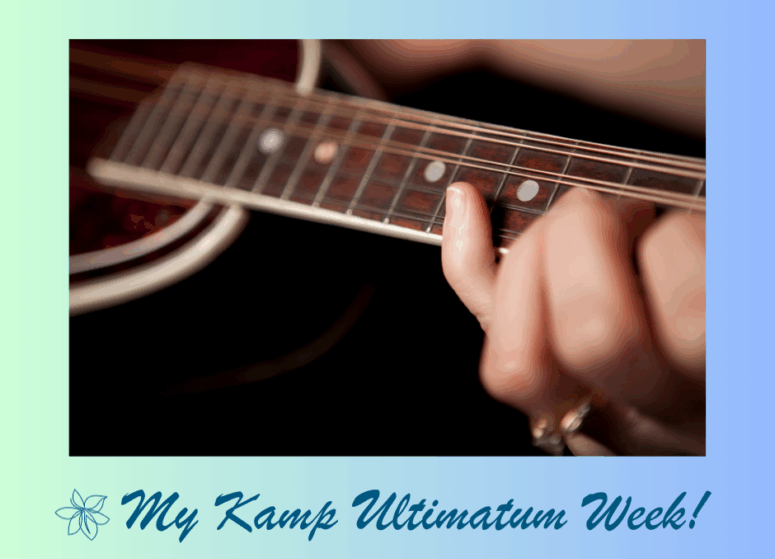
This year, I faced my biggest Kamp challenge. I made a promise several years ago to my wonderful musical husband, Barry, that I have struggled to fulfill. We have a duo, “Ridgeline Harmony.” I love singing harmony while he sings lead and plays guitar. When we play music with groups, he effortlessly switches between his guitar, mandolin, and bass. Not me. Not yet. Years ago, he bought me a beautiful mountain dulcimer, since he was certain anyone could learn to play a lap dulcimer. I completed one lesson but then got too busy with other things. After we started singing together (thanks to Kaufman’s Kamp), Barry astutely noticed how many girls in Bluegrass bands play mandolins! So, the next year, I had a beautiful mandolin of my very own to take to Kamp. I was nervously excited to start!

Our duo at Kaufman’s Acoustic Kamp
I struggled through the week-long mandolin class for folks like me who knew nothing about playing their instrument other than the name of the instrument. To use a mountain phrase, I was ‘lost as Hogan’s goat.’
That was just my second year (2018) at Kamp. I was still swimming upstream, trying to keep all that I was hearing, learning, and experiencing sorted out in my memory. Regardless of your skill level, Kamp is a week of full musical immersion, which I find creatively and emotionally invigorating. But I made meager progress in acquiring mandolin skills. Once home, the mandolin looked beautiful in its stand but longed to be held again. “Just keep practicing, memorize the chords and positions, and surely you’ll get there.” Maybe, eventually, I hoped. That might seem like sound advice, but now I see it as a flawed approach. My body and my mandolin felt like a physical mismatch. Practice (when and if it happened) quickly sparked pain, and back to the stand went my mandolin.
Still, every third week of July (excepting the 2020 pandemic year), we joyfully head up to Kamp to further curate our Kamp obsession. Every year, my mandolin tags along and gets bored sitting in our college dorm room at Maryville College. Each year, I sign up for anything except mandolin classes. My excuses were plentiful: too old to learn, fingers too weakened by arthritis, painful, awkward, can’t hear the chord changes, uncoordinated, etc.
Fast forward to the third week of June 2025; our 8th Kamp week would be my personal ultimatum year. It was time to ‘make good’ on my promise. I would go back to the 101 class and do it or quit. But quitting meant giving my mandolin to someone who would play it. I didn’t have the heart to let it go because it had a story, too, that I loved to tell even if I couldn’t play it. I actually tried to back out of class the week before camp but was kindly informed that the songwriting class had no openings left.
I was stuck! However, the good news this time around was Chris Talley, an amazingly talented, kind, and intuitive instructor. She had just the right blend of patience and nudging each of us forward. Imagine six adult beginners: two fiddles, one banjo, two guitars, and one mandolin in one small classroom learning to play individually and together.
And….drumroll….I made it through!!! So, the mandolin still has a safe home. Now that I can hold it properly, the pain has also gone away. It just took a few modifications by Chris to get me physically and emotionally comfortable. We are headed to play with our cousins tonight.
By now, you may be wondering: “What’s the point of my woeful, little tale?”
I want you to think about the learning process and the importance of context.
The first year that I went to Kamp, I knew nothing about Bluegrass style music except that Barry loves and plays it. I didn’t come to the Southeast until I was 40 (and then, not by choice). I was raised by parents who were classically trained vocalists, having met in voice lessons in high school. We didn’t have a piano (or any instruments), so my mother taught me to sing the alto part using a pitch pipe. I was in the sixth grade, and she needed me to create a trio with her (first soprano), my older sister (second soprano), and me (alto). Dad would preach, and the trio would sing in matching dresses that my mother made. Dad also directed the church choir, and we all knew our assigned places. At home, the radio dial never drifted from classical music.
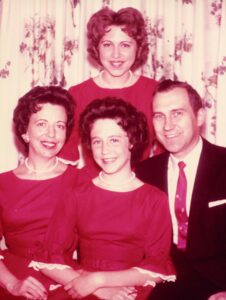 Our family trio
Context is crucial to successful learning.
My first exposure to Bluegrass, particularly old-time bluegrass, came with marrying Barry nearly 30 years ago. Before long, I could hear and sing parts of the harmony. But as his cousins will attest, as a newbie, I sometimes crossed into their harmony line. I ignored timing. I knew nothing about music theory and the relationships between chords and scales and all that other stuff. No wonder I couldn’t play an instrument.
Over our years at Kamp and jamming with friends and cousins at home, I began building a mental scaffold to hold the pieces of information that I was acquiring. I needed a way to assimilate new information with what I already knew. Over time, my mental scaffold began to grow through the processes of immersion, acquisition, and assimilation.
You can’t play or sing what you cannot hear. It is hard to hear and remember what you don’t understand. New information can easily get lost or become scrambled. It lacks mental placeholders within the broader context of musical forms and genres.
Perhaps it is like learning to read. I am told that knowing letter names is strongly related to children’s ability to remember the forms of written words and their ability to treat words as sequences of letters. In fact, it is a strong predictor of their success in learning to read.
As I mulled this over, I thought of other life applications. Faith in God came to mind first. Because of God’s abundant goodness in my life, I love sharing snippets of my faith with others. Some people receive it as a joyful blessing. Others respond with a questioning or blank look. Where I see God’s goodness and glory in the morning sky, they see just a normal day. The relational context of God as my Creator, Father, and Savior changes how I experience life.
Couple relationships also require contextual learning and understanding to integrate the two unique mindsets, beliefs, and practices learned in their family of origin. The results of that evaluation help them set their ‘couple trajectory’ for success. Otherwise, we could mindlessly repeat our mistakes and those of the past generation.
Couples who are blending families face those same challenges in multiple ways and contexts. I don’t know of anyone who planned for divorce or the death of a spouse when they first got married. So, if and when that happens, they face a jumbled set of pieces that no longer fit their mental image of family and may conflict with their belief system.
That spells rough roads ahead. If couples (or siblings) repeatedly argue over the same points, perhaps there is a relational context that you need to consider. It’s tough. I’ve been on that rollercoaster of emotions, struggling to get from surviving to thriving.
Why do I love helping Blended Families?
Because I want them to have the help that we needed but didn’t find thirty years ago.

My Kamp Ensemble (randomly assigned Kampers)
Remember, you are never too old to learn new skills.
Life is too short not to try.